

C-T.31: SULALA: Explainable Machine Learning for Identifying cis-Regulatory Elements Across Developmental Trajectories
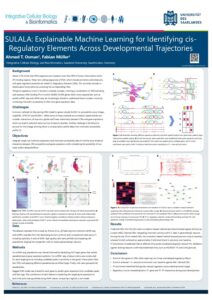
Paired single-cell multiome profiling of chromatin accessibility and gene expression is rapidly becoming routine, with PubMed query counts suggesting a sharp increase in multiome publications from ~74 (2022) to ~202 (2024), comparable to unimodal single-cell accessibility studies (~93 in 2022; ~194 in 2024). This growth highlights an urgent need for methods that analyze multiome data jointly rather than treating modalities independently. Accessibility alone cannot distinguish merely open elements from those that actively regulate transcription, nor capture temporal delays between chromatin opening and RNA changes
We present SULALA, a background-corrected, game-theoretic framework for enhancer–gene linking from paired scATAC+scRNA data. SULALA fits a bootstrapped non-linear support vector regression (SVR) model to predict gene expression from local accessibility and uses SHAP-based feature attribution to quantify region-level contributions. To preserve single-cell heterogeneity beyond cell-type averages, SULALA infers links at the level of pseudobulks along pseudotime, enabling within-cluster regulatory variation. It further incorporates trajectory-aware modeling to accommodate temporal lag between accessibility and expression and controls spurious associations via background-calibrated link scoring.
Across brain and epiblast multiome datasets, SULALA yields higher-precision, high-confidence enhancer–gene links than correlation-based methods and distance-only baselines (precision lift: 1.53 and 1.42, respectively). Analyses reveal stage-specific increases in enhancer activity at key developmental transitions, including glutamatergic neuron differentiation and critical epiblast stages (day 7, amniotic early/late, definitive endoderm, neuroectoderm). By producing a peak–gene link strength matrix across pseudotime and enabling motif-level aggregation, SULALA supports dynamic, fine-grained gene regulatory network and transcription factor activity inference beyond canonical cell types.
Co-authors: Fabian Mueller
Contact Attendee
Warning: Attempt to read property "user_email" on string in /home/1276969.cloudwaysapps.com/ydbgzhdjeq/public_html/wp-content/plugins/my-conference-now/functions.php on line 2826