

C-S.B.25: To Translate or Not: Multistable Decision-Making in Translation Initiation under Normal Conditions and Integrated Stress Response
Authors
Center for Computational Biology, Department of Computational Biology, IIIT-Delhi, INDIA
K Sriram
Center for Computational Biology, Department of Computational Biology, IIIT-Delhi
[sponser-meet-now-chat][/sponser-meet-now-chat]
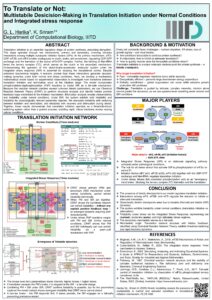
Translation initiation is an essential regulatory stage of protein synthesis, preceding elongation. This stage operates through two mechanisms, primary and secondary, involving complex interactions among multiple eukaryotic initiation factors (eIFs). In the primary mechanism, eIF2-GDP, eIF2B, and eIF5 function analogously to clutch, brake, and accelerator, regulating GDP-GTP exchange and the formation of the active eIF2-GTP complex. Further, the binding of Met-tRNA forms the ternary complex (TC), which serves as the clutch in the secondary mechanism. Understanding the operation of this clutch-brake-accelerator molecular system under the integrated stress response (ISR) is essential for studying the translational control. Despite extensive biochemical insights, it remains unclear how these interactions generate decision-making dynamics under both normal and stress conditions. Here, we develop a mechanistic mathematical model based on experimental observation to investigate how transitions between translation initiation and termination occur at the initiation stage. The model incorporates phosphorylation-dephosphorylation (PdP) reactions to model ISR as a fail-safe mechanism. Because the reaction network contains several unknown kinetic parameters, we use Chemical Reaction Network Theory (CRNT) to perform structural analysis and identify hidden positive feedback loops embedded in the initiation mechanism. Bifurcation analysis reveals ultrasensitivity and bistability under normal conditions. Under ISR, the system exhibits both bistability and tristability for physiologically relevant parameter regimes. We associate bistability with switching between initiation and termination, and tristability with recovery and attenuation during stress. Together, these results demonstrate that translation initiation operates as a threshold-driven switching system rather than a graded process, enabling rapid, robust decisions across varying cellular conditions.
Co-authors: Sriram K
Contact Attendee
Warning: Attempt to read property "user_email" on string in /home/1276969.cloudwaysapps.com/ydbgzhdjeq/public_html/wp-content/plugins/my-conference-now/functions.php on line 2826