

C-P.29: AI-driven Intrabody Design: Representation Learning and Multi-objective Optimization of Nanobody Frameworks
Author
Keywords
Intrabodies, Nanobodies, Protein Language Models, ESM2, Generative Protein Design, Structural Bioinformatics, AlphaFold-Multimer, FoldX, Intracellular Stability, Antibody Engineering, Survivin, Framework Regions, Machine Learning
[sponser-meet-now-chat][/sponser-meet-now-chat]
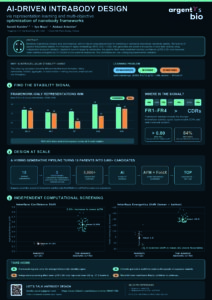
Intrabodies are intracellular antibody fragments that enable targeting of proteins inaccessible to conventional biologics, but their development is limited by poor stability in the reducing cytoplasmic environment. As a result, intrabody engineering remains largely empirical and lacks scalable computational approaches.
We present an AI-driven pipeline for intrabody design that integrates protein language model–based representation learning, supervised stability prediction, and generative nanobody optimization. Sequence embeddings derived from pretrained models (ESM2, ProtT5, IgT5) are used to train machine learning classifiers for predicting intracellular stability of nanobodies. Models trained only on framework regions of nanobodies outperform full-sequence models, achieving ROC-AUC > 0.80, indicating that stability-related signals are primarily encoded in framework residues.
To explore sequence space, we implement a hybrid generative pipeline combining consensus-based framework mutagenesis (consensus nanobody sequence based on a set experimentally validated stable intrabodies), language model–guided sequence infilling, and stochastic diversification. More than 5,000 candidate nanobody variants are generated from a small set of parental sequences.
Generated variants are evaluated using independent structure-based metrics not used during model training, including AlphaFold-Multimer interface confidence (ipTM) and FoldX interface energies. Top candidates show a strong shift toward higher predicted interaction confidence (ipTM ~0.55–0.75 vs. ~0.1–0.2 in parental sequences) and more favorable binding energetics (median FoldX ΔG shifts from ~−5 to ~−25 kcal/mol, with reduced variance across top-ranked variants).
Selected candidates are currently undergoing experimental validation. These results demonstrate that combining representation learning, generative design, and structure-based screening enables scalable computational intrabody engineering.
Co-authors: Ilya Mazo, Aleksei Artemiev
Contact Attendee
Warning: Attempt to read property "user_email" on string in /home/1276969.cloudwaysapps.com/ydbgzhdjeq/public_html/wp-content/plugins/my-conference-now/functions.php on line 2826