

B-T.06: Benchmarking Interventional Causal Structure Learning for Gene Regulatory Network Inference
Causal structure learning offers a promising approach to studying gene regulation in cells, aiming to provide deeper mechanistic insights than purely association-based methods. Theoretical groundwork indicating that interventions improve identifiability of causal structure motivates the use of causal structure learning methods in scenarios with interventional information.
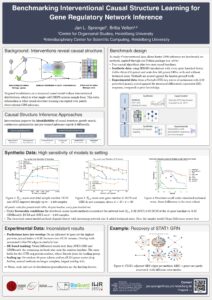
This benchmark investigates the ability of existing causal structure learning algorithms to leverage the interventional information revealed by single-cell CRISPR screens to infer gene regulatory networks (GRNs). In this study both synthetic and experimental single-cell CRISPR perturbation data is leveraged, and a suite of causal structure learning algorithms is evaluated on metrics tailored to synthetic ground truth and real biological data respectively. On synthetic data, accurate recovery of GRNs is achieved under favourable conditions by score-based (GIES) and neural causal methods (DCDI, AVICI): strong interventions, large sample sizes, and low measurement noise. However, under more challenging conditions, prediction accuracy is shown to reduce, in particular when applying realistic technical noise. Similarly on real data, performance remains unreliable, limited by technical and biological noise, as well as algorithmic scalability. This demonstrates a current gap between theoretical potential and practical application of causal structure learning for GRNs.
The benchmark provides insight into algorithm strengths and limitations, showing simpler empirical baselines such as GRNBoost2 and Mean Difference remain competitive under realistic noise conditions, and offers groundwork for further methodological development. We also provide an accessible software package to leverage modern causal structure learning on custom datasets.
Co-authors: Britta Velten
Contact Attendee
Warning: Attempt to read property "user_email" on string in /home/1276969.cloudwaysapps.com/ydbgzhdjeq/public_html/wp-content/plugins/my-conference-now/functions.php on line 2826