

B-S.B.16: A Geometric View of Community Metabolism
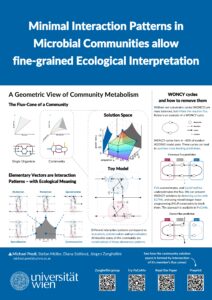
Microbial communities are abundant in nature, drive major biogeochemical cycles, and are integral to our health. Metabolic models promise mechanistic insights into community metabolism, including interactions such as competition and cross-feeding of nutrients.
Although community metabolic models are built from linear models of individual organisms, their solution space is non-linear, rendering standard single-organism methods insufficient.
Here, we present a new geometric perspective on community metabolic modelling. We extend metabolic pathway analysis to microbial communities by defining community-level elementary flux modes (cEFMs). These modes generalize single-organism EFMs and form minimal building blocks of community metabolism. Each cEFM explicitly captures nutrient uptake and metabolite exchange between all community members, which further admits a direct ecological interpretation, distinguishing interaction types such as mutualistic or commensal modes.
Crucially, this cEFM-based perspective also resolves a long-standing problem in metabolic modeling: thermodynamically infeasible cycles (TICs) across organisms. In community models, TICs commonly arise when different organisms catalyse opposing conversions, leading to inflated flux values and spurious cross-feeding predictions. We show that upon blocking external metabolite inflow, enumeration of cEFMs reveals all TICs present in the system. Incorporating simple activity-based constraints from these modes into an MILP yields cycle-free solutions, even at the genome scale.
The presented geometric view provides an important improvement in the analysis of microbial communities by removing technical artefacts in the prediction of interactions and by offering a fine-grained ecological interpretation of community metabolism.
Co-authors: Stefan Müller, Diana Széliová, Jürgen Zanghellini
Contact Attendee
Warning: Attempt to read property "user_email" on string in /home/1276969.cloudwaysapps.com/ydbgzhdjeq/public_html/wp-content/plugins/my-conference-now/functions.php on line 2826