

B-G.32: Determinants of functional burden pleiotropy and gene dosage responses across human traits
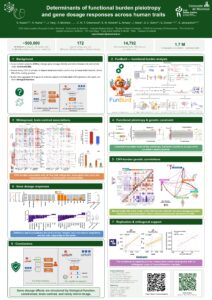
Gene dosage alterations, such as rare copy-number variants (CNVs), are major drivers of disease risk and whole-body multimorbidity. Their rarity makes deciphering this biological footprint challenging. To overcome this statistical limitation, we developed Functional Burden analysis (FunBurd), aggregating protein-coding CNVs across 172 transcriptomic-derived tissue and cell-type networks. Applying this to 43 complex traits in ~500,000 UK Biobank participants, we captured widespread functional associations missed by single-gene approaches. Mapping this architecture revealed a unifying principle: CNV pleiotropy is fundamentally restricted by evolutionary constraint and overwhelmingly concentrated within brain-specific functions. Crucially, mediation analysis proved these pleiotropic links are driven overwhelmingly (~84%) by direct CNV effects. This architectural constraint simultaneously governs gene dosage responses. Highly conserved brain functions, intolerant to dosage deviation, exhibited predominantly non-monotonic (same-direction) effects, whereas less constrained non-brain traits followed traditional monotonic rules. Within these brain functions, we uncovered profound sex differences: females exhibited a significantly higher proportion of deletion-driven associations for mental health traits. We successfully replicated these associations in an independent, ancestrally diverse cohort of ~500,000 All of Us participants. Furthermore, deletion burden demonstrated positive effect size correlations (up to r=0.78) with rare pLoF SNVs across 87% of traits, confirming that the effects captured by the functional burden test are consistent with an independent class of loss-of-function variants. Our results highlight the key role of genetic constraint and brain-specific mechanisms in shaping CNV-driven pleiotropy and monotonic gene-dosage response, providing a mechanistic basis for the whole-body multimorbidity observed in neurodevelopmental and psychiatric conditions.
Co-authors: Omar Shanta, Sebastien Jacquemont, Guillaume Dumas, David Glahn, Jonathan Sebat, Almasy Laura, Stephen W. Scherer, Celia M. T. Greenwood, Jeffrey R. MacDonald, Bhooma Thiruvahindrapuram, Kuldeep Kumar, Worrawat Engchuan, Emma E.M Knowles, Laura M. Schultz, Thomas Renne, Josephine Mollon, Guillaume Huguet, Florian Benitiere, Jane YangContact Attendee
Warning: Attempt to read property "user_email" on string in /home/1276969.cloudwaysapps.com/ydbgzhdjeq/public_html/wp-content/plugins/my-conference-now/functions.php on line 2826