

A-T.44: Benchmarking Regulatory Variant Effect Predictors across Three Distinct MPRA Cellular Contexts
Keywords
Bioinformatics Regulatory-Genomics Variant-Interpretation Modelling AI
[sponser-meet-now-chat][/sponser-meet-now-chat]
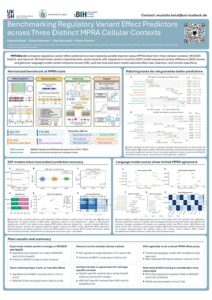
Accurate interpretation of non-coding variants requires predictive models that identify sequence changes and evaluate experimentally measured regulatory effects throughout diverse cellular contexts. We present MPRABench, a harmonized benchmarking workflow for comparing predictive models of regulatory variant effects using large-scale MPRA datasets. We evaluated six models using IGVF-MPRA assays in HEK293T, HepG2, and neuronal progenitor cells. The datasets included 147,485, 147,532, and 38,684 tested variants, yielding 15,950, 9,892, and 1,016 significant allelic effects (adjusted q-value < 0.1), respectively. Supervised "sequence-to-function" models captured significant MPRA signals, including effect direction, in HEK293T and HepG2 cells. AlphaGenome performed best (Spearman rho = 0.680 and 0.616), followed by Basenji2 (0.603 and 0.525) and Enformer (0.582 and 0.531). Across all architectures, performance was much lower in neuron progenitors (rho = 0.147–0.185), suggesting a limitation specific to this neuronal MPRA context. Aggregation restricted to cell-type- or assay-specific tracks showed no universal advantage. Performance gains varied by model, assay class, and cellular context. Post-hoc analyses of individual tracks identified informative tracks diluted by simple averaging. Variant impact scores based on genomic language models (HyenaDNA, DNABERT-2, and NTv3) showed little agreement with the magnitude or direction of MPRA effects, although NTv3 Post correctly captured the direction of effect in HEK293T and HepG2 cells. These results demonstrate that current predictors capture the impact of regulatory variants unevenly across cellular contexts and that score directionality, track selection, and assay design are critical for interpreting model performance.
Contact Attendee
Warning: Attempt to read property "user_email" on string in /home/1276969.cloudwaysapps.com/ydbgzhdjeq/public_html/wp-content/plugins/my-conference-now/functions.php on line 2826