

A-T.42: Cell type composition drives patient stratification in single-cell RNA-seq cohorts
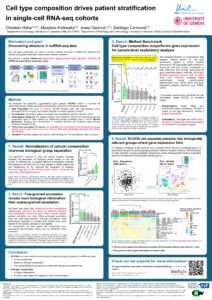
Background: Unsupervised patient stratification using single-cell RNA-sequencing (scRNA-seq) has the potential to reveal clinically relevant disease subtypes. While complex computational methods have emerged to represent sample-level data, they often ignore the compositional nature of cell-type proportions and lack interpretability.
Methods: We benchmarked seven state-of-the-art sample representation methods across eleven diverse scRNA-seq cohorts for their ability to recover known biological groupings in an unsupervised setting. We compared them against simple baseline approaches, including pseudobulk gene expression and Centered Log-Ratio (CLR) transformed cell-type compositions.
Results: Surprisingly, we found that simple compositional baselines consistently match or outperform complex methods in recovering biological groupings. CLR-transformed cell-type proportions achieved the highest stratification performance while being robust to batch effects and requiring orders of magnitude less computational power. Our analysis revealed that stratification signals are often concentrated in a small subset of highly variable cell types, making the results highly interpretable.
Conclusions: Our results suggest that cell-type composition is the primary driver of clinically relevant inter-sample variation in scRNA-seq cohorts. To facilitate these analyses we introduce scECODA, an open-source R Bioconductor package for scalable and interpretable cohort-level Exploratory COmpositional Data Analysis.
Co-authors: Massimo Andreatta, Santiago Carmona
Contact Attendee
Warning: Attempt to read property "user_email" on string in /home/1276969.cloudwaysapps.com/ydbgzhdjeq/public_html/wp-content/plugins/my-conference-now/functions.php on line 2826