

A-S.B.36: How to predict effective drug combinations – moving beyond synergy scores
Authors
Department of Medical Bioinformatics, University Medical Center Göttingen (UMG), Germany
Kerstin Lenhof
Lutz Herrmann
Lisa-Marie Rolli
Hans-Peter Lenhof
[sponser-meet-now-chat][/sponser-meet-now-chat]
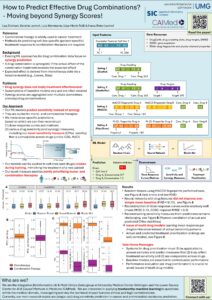
In cancer therapy, combining multiple drugs is a common strategy to circumvent treatment resistance and reduce side effects. Existing machine learning (ML) approaches for estimating drug combination responses mainly focus on predicting synergy scores that measure the synergistic or antagonistic potential of two drugs. While synergy scores can support drug development and repurposing efforts, they rely on theoretical assumptions unlikely to hold in vivo. Moreover, drug synergy does not inherently guarantee treatment effectiveness. These factors heavily impede the applicability of synergy scores for deriving personalized treatment recommendations.
To overcome these limitations, we pioneer ML models that predict treatment responses directly, without relying on synergy scores: Our models predict the inhibition of cell growth at specific concentrations of one or more drugs defined in the model input. Notably, our approach is the first to provide dose-specific predictions of drug (combination) sensitivity for cell lines and drugs not used during model training. Thereby, we effectively mimic the challenge of predicting responses for previously unseen cancer patients or newly developed compounds. Furthermore, any conventional measure of drug sensitivity or synergy can be reconstructed from the predictions, making our approach highly flexible and suited for various tasks. In a large-scale benchmarking of the DrugComb database, we compare different ML algorithms and input representations. As an application in personalized treatment recommendation, we showcase that our models can accurately rank the most effective mono- and combination therapies for a given cell line using an extension of our recently developed sensitivity measure (CMax viability) to two-drug combinations.
Co-authors: Kerstin Lenhof, Lutz Herrmann, Lisa-Marie Rolli, Hans-Peter Lenhof
Contact Attendee
Warning: Attempt to read property "user_email" on string in /home/1276969.cloudwaysapps.com/ydbgzhdjeq/public_html/wp-content/plugins/my-conference-now/functions.php on line 2826