

A-ELIXIR.01: Building a community-driven linked knowledge graph for plant specialized metabolism
Elena Del Pup
Bioinformatics group, Department of Plant Sciences, Wageningen University & Research, Wageningen, the Netherlands
Egon Willighagen
Translational Genomics, Maastricht University, Maastricht, the Netherlands
Kumar Saurabh Singh
Brightlands Future Farming Institute, Maastricht University, the Netherlands
Denise Slenter
Translational Genomics, Maastricht University, Maastricht, the Netherlands
Marnix Medema
Bioinformatics group, Department of Plant Sciences, Wageningen University & Research, Wageningen, the Netherlands
Justin van der Hooft
Bioinformatics group, Department of Plant Sciences, Wageningen University & Research, Wageningen, the Netherlands
Keywords
plant specialized metabolism; linked open data; knowledge graph; integrated multiomics; plant natural products
[sponser-meet-now-chat][/sponser-meet-now-chat]
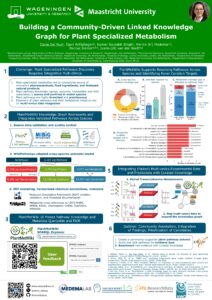
Plant specialized metabolites are a major source of innovative pharmaceuticals, novel foods, and biobased natural products. However, resolving the metabolic pathways that biosynthesize these compounds remains a key scientific challenge, as plant biosynthetic genes are often dispersed and duplicated, resulting in highly branched, diversified, and promiscuous underlying metabolic networks. Additionally, knowledge of plant metabolic pathways remains scattered across disconnected resources, with limited interoperable annotations, and valuable experimental multi-omics datasets remain siloed and underused. Currently, researchers lack an open, standardized, and reusable AI-ready format for integrating new datasets with community knowledge. Additionally, there is no framework to systematically link computational evidence from bioinformatics tools and paired plant transcriptomics-metabolomics datasets to predict or validate pathway-level knowledge. To address these gaps, we developed the Linked Open Data knowledge graph PlantMetWiki (https://plantmetwiki.bioinformatics.nl/), the first semantically enriched knowledge base for querying experimentally validated pathway information for plant biosynthetic reactions across 643 species, including predictions of biosynthetic gene clusters. PlantMetWiki provides a foundational and extendible framework for community curation, enabling the future integration of experimental data on predicted biosynthetic pathways. This extension involves creating a community-supported validation schema to align and integrate multi-omics datasets, and a scoring method for predictions from multi-omics bioinformatics pipelines, interoperable with existing standards.
These developments will support an open-source knowledge base and a Linked Open Data community for scalable community annotation of pathway information, improved integration of multi-omics data, collaborative hypothesis generation on plant specialized biosynthesis, and prioritization of candidate pathway components of plant natural products.
Co-authors: Elena Del Pup, Egon Willighagen, Kumar Saurabh Singh, Marnix Medema, Denise Slenter, Justin van der Hooft
Contact Attendee
Warning: Attempt to read property "user_email" on string in /home/1276969.cloudwaysapps.com/ydbgzhdjeq/public_html/wp-content/plugins/my-conference-now/functions.php on line 2826